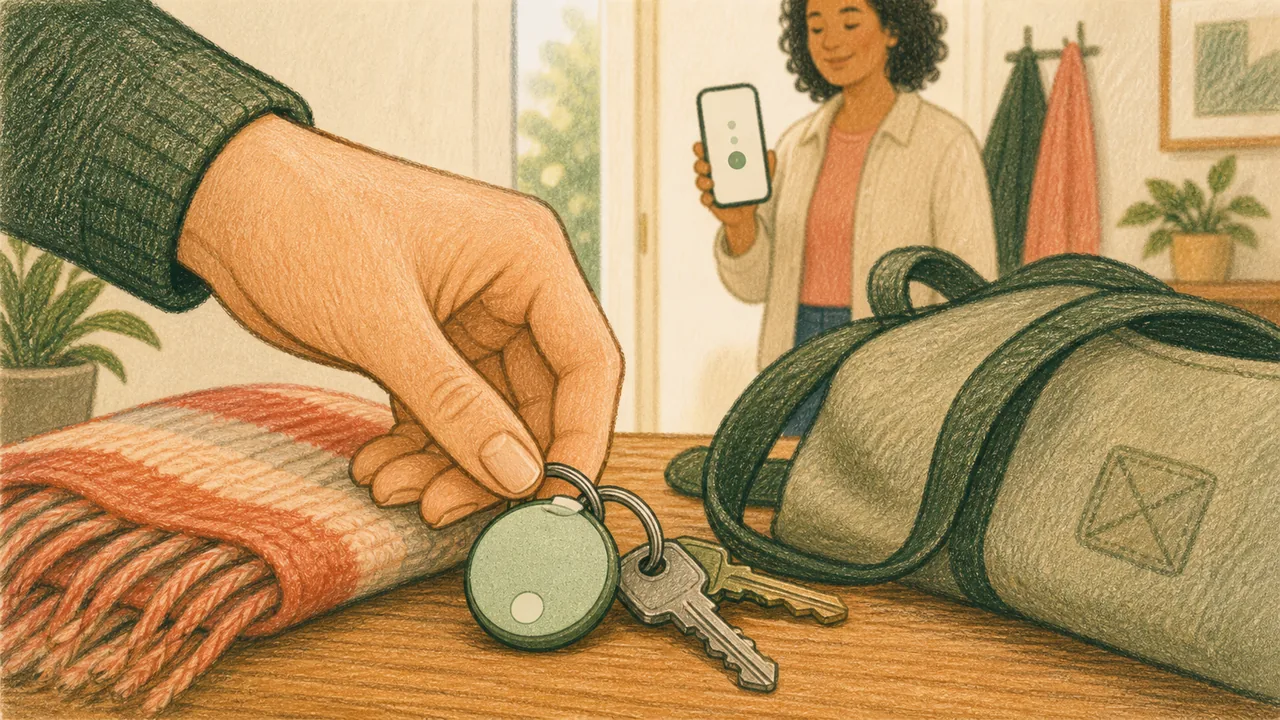
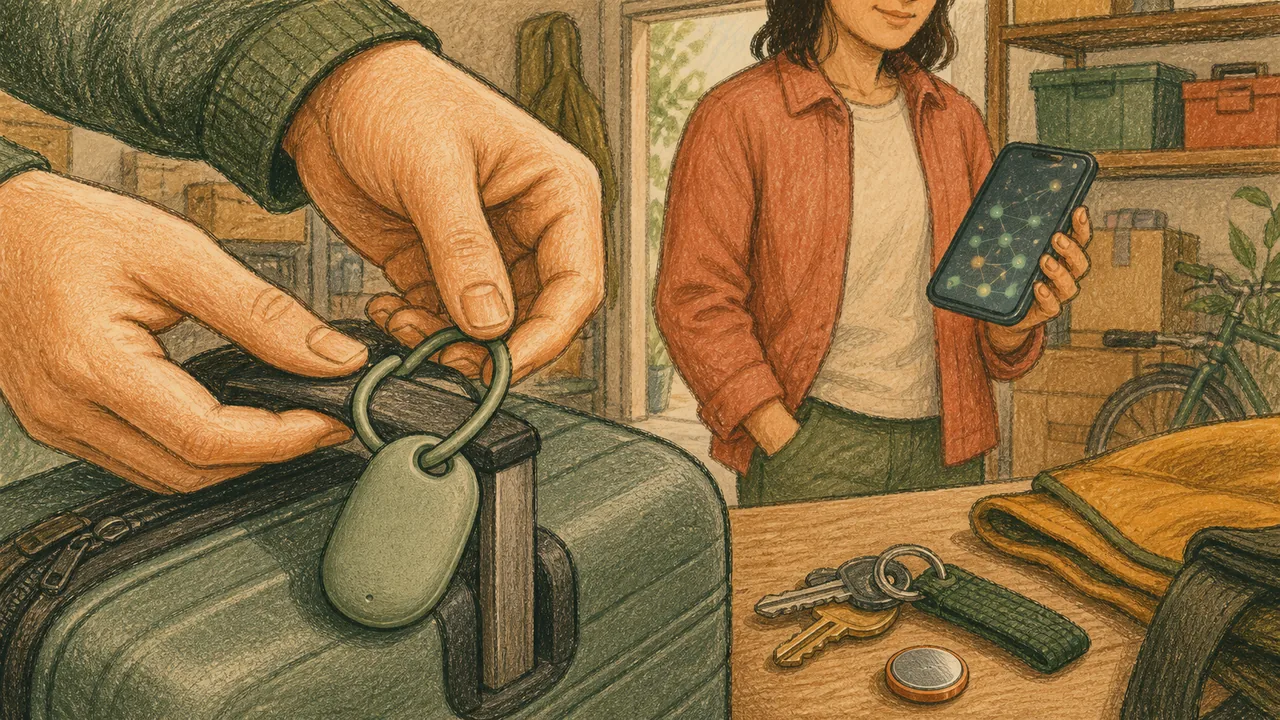
Item trackers all look interchangeable in a listing photo, and the thing that actually decides which one works for you is invisible in it: each tag is only as good as the phone network that finds it, and each of the three below is locked to a different one. Size is the second question, because a tag you will not carry never gets tested. These are the four questions to settle, answered from each product record’s cited claims.
Which phones can find it at all
Settle this before anything else, because a tracker outside your household’s ecosystem is a beeping keyring, not a finder. The Apple AirTag needs an Apple Account and an iPhone running iOS 26 or later, or an iPad running iPadOS 26 or later — and Precision Finding is supported on a narrower, region-dependent set of devices than the tag itself. The Tile Mate 2024 is the cross-platform one: it works with both iOS and Android, through the Tile and Life360 ecosystem. The Samsung Galaxy SmartTag2 is the narrowest of the three, requiring a compatible Samsung Galaxy device, a Samsung account and SmartThings Find. A mixed-phone household is the case where the Tile Mate’s wider reach earns its place.
How big it actually is, and how it attaches
This is the question the specs pages bury and it is worth answering plainly, because the two shapes are not the same object. Apple lists the AirTag at 1.26 inches (31.9 mm) across, 0.31 inch (8.0 mm) thick and 0.42 ounce (11.8 grams) — a small, thick disc. A hands-on review lists the Tile Mate 2024 at 1.5 by 1.5 by 0.29 inches: wider than the AirTag, marginally thinner, and square rather than round. The practical difference is attachment, not footprint. Tile builds a key-ring loop into the Mate, so it goes onto keys as bought; the AirTag record lists no attachment point of its own, so budget for a holder if keys are where it is going. In a bag or a jacket lining, the AirTag’s smaller diameter is the one that disappears.
Whether the battery is a refill or an expiry date
The two evidenced records differ on this in a way that changes what you are buying. The AirTag takes a user-replaceable CR2032 coin cell and is rated IP67 under Apple’s stated test conditions, so a flat battery is a supermarket errand. Tile claims up to three years of battery life for the Mate, which sounds like the better number until you read the trade-off the same hands-on review records: the battery is not replaceable. That makes three years the tag’s working life rather than its service interval, so the honest comparison is a replaceable cell against a disposable tag. On price, only one of the three records exposes a stable figure — Apple’s U.S. storefront showed $29 for a one-pack on 2026-08-08 — while neither the Tile Mate nor the SmartTag2 record carries a current price, so check both at a retailer rather than trusting a number here.
What these are not, and what one reviewer each actually found
All three records are explicit that these are item finders, not child or pet safety devices: Apple says the AirTag is designed to track items and not people, and an item-finder network carries coverage gaps and refresh delays that make it unsuitable as real-time safety tracking. On the privacy side of the same coin, Apple states that location and history are not stored on the AirTag itself, that relayed location data is encrypted with devices kept anonymous, that a tag can be shared with up to five people, and that iPhone and Android alerts plus an audible sound are there to discourage unwanted tracking. The hands-on evidence behind each profile is one reviewer, not a consensus. One named reviewer bought four AirTags and repeatedly found the second generation louder with better Precision Finding than the first. Tom’s Guide, testing key finders for a decade, called the Tile Mate 2024 the best-value current Tile and reliable in use, while recording shorter range than promised and the fact that its discreet SOS alert and two-way phone finding cannot both be enabled at once. Family Tech Finder has not hands-on tested any of the three.